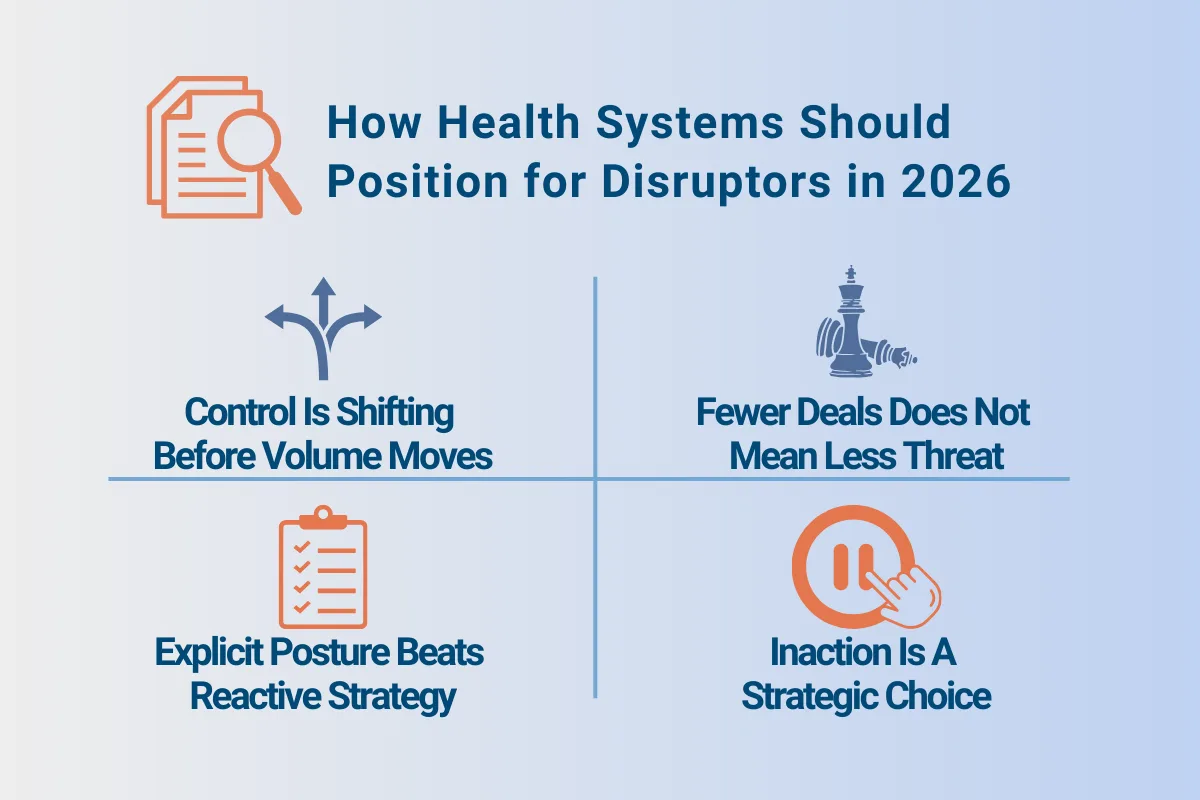
How To Use This Guide
This tool is designed to help assess where service line control is eroding before volume or margin moves and to guide strategic decision-making.
Use it to:
Regularly stress‑test each priority service line (e.g., quarterly or biannually)
Identify blind spots early
Align leadership attention and capital to where leverage is shifting
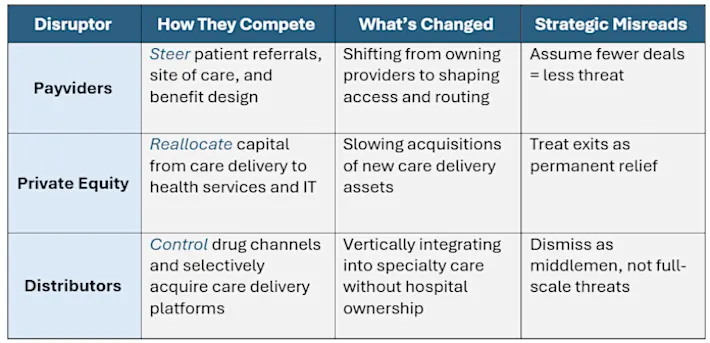
How Disruptors Are Actually Competing in 2026
Beyond the headlines, here’s how disruptors are behaving now—and where health systems most often misread where control is moving.
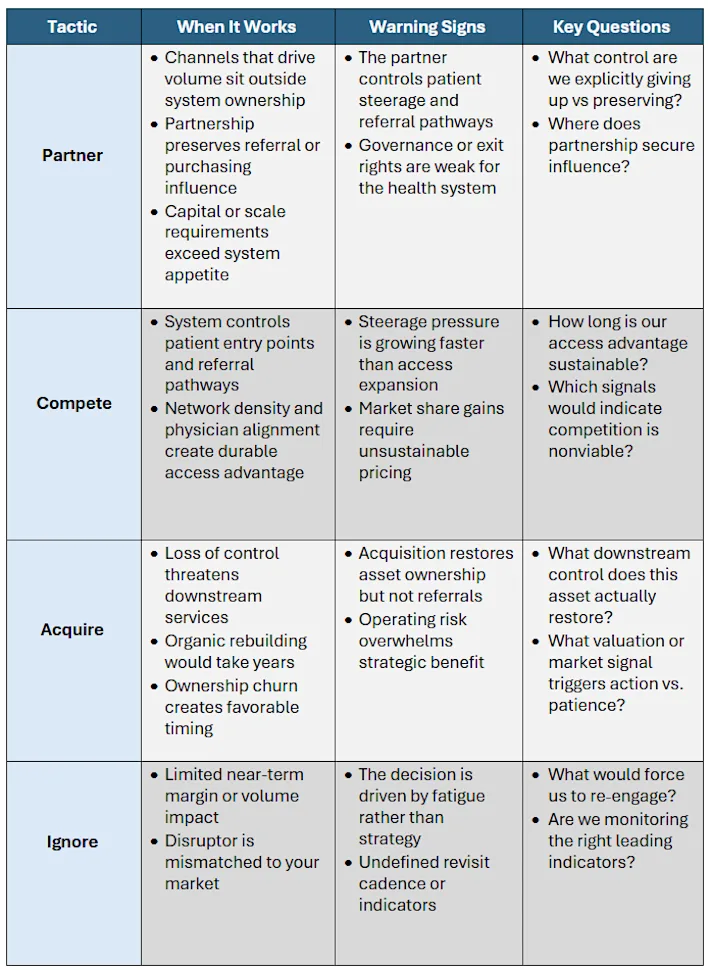
Health System Responses to Disruptor Activity
In today's market, the greatest strategic risk is not choosing the wrong response—it is delaying the choice. Control often shifts upstream quietly, long before volume or margin signals appear. Systems that decide explicitly, by service line, will retain far more leverage than those reacting after other players have already moved.
Across service lines, disruptor activity drives four primary response paths:
The 5 Guiding Questions for Responding to Disruptors in 2026
1. Where do we need ownership vs. influence?
Why it matters: Utilization is increasingly steered before patients reach assets, shifting leverage from delivery ownership to control of access, benefits, and referral defaults.
Consider: Which specific access or referral decisions that drive our volume are now controlled by entities we do not contract with, own, or meaningfully influence?
2. Which service lines must be defended vs. selectively exited?
Why it matters: Steerage-exposed SLs often deteriorate structurally before volume or margin declines are visible, compressing the window to respond once warnings appear.
Consider: Which lines are most sensitive to steerage vs. clinical differentiation? Where would volume loss appear last in enterprise reporting?
3. Where does partnership preserve more control than competition?
Why it matters: As payviders and distributors consolidate control, competing without channel leverage increasingly results in symbolic wins but real loss of influence.
Consider: Where are we competing primarily because of legacy identity, not structural advantage?
4. Which assets should we be ready to reacquire?
Why it matters: Market corrections and PE exits create short, asymmetric windows to reacquire assets that restore access or influence.
Consider: Which assets we no longer own—or never owned—now determine our margin stability more than our core delivery footprint?
5. What are we intentionally ignoring?
Why it matters: Unexamined inaction is riskier than an explicit strategic posture.
Consider: Have we explicitly chosen our disruptor response by service line? Which “ignore” decisions would be hardest to unwind—and who owns revisiting them?
The Strategic Imperative
In 2026, sustaining leverage requires explicit service line strategy, not implicit assumptions. This guide helps strategy leaders drive clear posture decisions and maintain enterprise alignment through a disciplined review cadence. As control has shifted upstream, strategic advantage is preserved by setting service line posture in advance of disruptor moves, not in response to their downstream effects.