Insights
THMA's Weekly Essentials
Upcoming Events
Browse by Topics
Featured All-Access Insights


Podcasts
The Strategist in Brief: September 17, 2026
Listen to the episode on a streaming platform by clicking one of the links below:
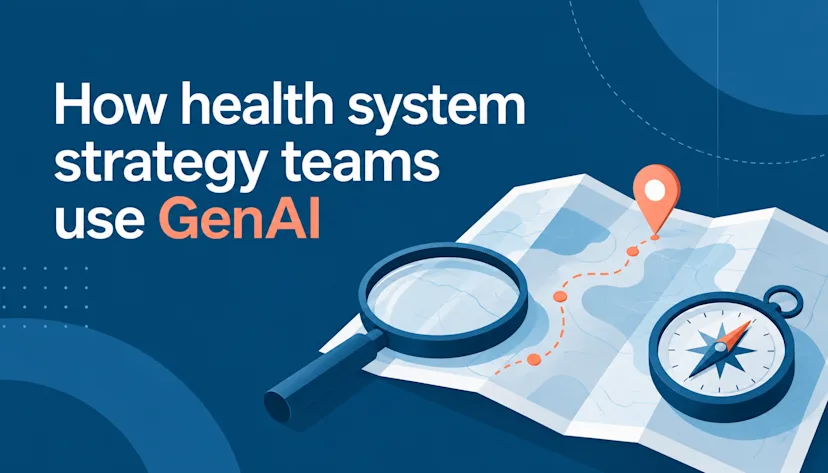
We asked a half dozen health system strategy leaders how their teams use GenAI for strategic planning work.
Information gathering is a top use case: some strategy teams use AI to size up markets faster, build competitor and hospital profiles, and reach a point of view on acquisition targets.
Several teams use AI to create finished deliverables, but verification and cleanup work can be time intensive.
Some teams are forced to stick with organizationally sanctioned AI tools that are clunkier than popular consumer tools like ChatGPT and Claude, which slows adoption.
At a recent roundtable discussion hosted by Strategy Catalyst, health system strategy leaders discussed different approaches to physician alignment and growth.
Many health systems employ multiple alignment strategies at the same time. The right model can vary by market or service line.
Health systems are facing pressure from rising costs for hospital-based specialties and competition from private equity.
This week’s featured graphic looks at average CEO tenures across different industries, based on data from Crist Kolder Associates. Healthcare is middle-of-the-pack, with an average tenure of 6.4 years.
A separate survey of health system CEOs specifically, by the consultancy SullivanCotter, found an average tenure of just over seven years.
This week’s lead news flash: Johnson & Johnson will require 340B providers to submit claims data to receive discounts, following in the footsteps of Eli Lilly and Novo Nordisk.
The Strategist in Brief: September 3, 2026
Listen to the episode on a streaming platform by clicking one of the links below:
Epic recently unveiled Ergo Visit, a platform that combines the company’s AI tools into a single workflow that assists clinicians before, during, and after an outpatient visit.
The announcement caught our attention because the ongoing migration of care to outpatient settings has turned the office visit into a key battleground where systems compete for access, patient loyalty, and increasingly scarce physician time.
To learn more, we interviewed Falyn Curtis, VP of Clinical Systems at Ochsner Health, the first system to put the tool into clinical use.
One month in, Ochsner is judging the tool on how physicians perceive it—less burnout, faster chart completion—rather than measurable ROI. The system is using time savings to ease physician workload and strengthen the patient-provider relationship rather than booking more patients.
Ochsner leans on layered AI governance including an AI Center of Excellence, an AI steering committee, and frontline clinicians to vet new tools as AI increasingly shapes clinical decisions.
New data from Aon forecasts that U.S. employer health costs will rise 9.5% in 2027, continuing an elevated trend for the past four years.
On the other hand, data from the Bureau of Labor Statistics shows that health benefit spending is relatively stable as a share of total worker compensation. Instead, rising healthcare costs are translating into higher out-of-pocket spending.
Payers also report that AI upcoding is driving up healthcare spending.
More than 40 health systems across the country have posted alerts about a MyChart phishing scam that targets seniors with free Medicare kits or wellness packages.
As the industry-leading EMR vendor, Epic is a proven partner but also a recognizable target for bad actors.
Phishing scams predominantly target older Americans, making an aging patient population a ripe target. At past THMA forums, we’ve also heard about C-suite leaders and highly compensated physicians getting targeted by bad actors.
Inside Oura's Counsel Health Integration: Consumer AI and the Front Door to Care
Listen to the episode on a streaming platform by clicking one of the links below:
In this episode of The Strategy Catalyst Dispatch, Ricky Bloomfield, MD, Chief Medical Officer at Oura, walks us through the company's partnership with Counsel Health, which connects Oura members to a board-certified physician asynchronously without leaving the app. We cover what Oura was seeing in consumer behavior that pulled the company toward care delivery, why they built the experience around messaging rather than video visits, and Dr. Bloomfield's perspective on how consumers are actually using AI in their own health.
The Strategist in Brief: August 6, 2026
Listen to the episode on a streaming platform by clicking one of the links below:
This week’s edition offers four predictions about payer mix headwinds, 340B rebates, cybersecurity, and clinical AI.
Prediction #1: The ACA Exchange-driven payer-mix hit will keep deepening through H2 2026, and the for-profits' full-year guidance marks the trajectory the rest of the sector is on.
Our Call: The H2 2026 self-pay and bad-debt hit could land harder than mid-year budgets assume. The question is whether it's in your FY2027 budget or discovered against it.
Prediction #2: By the end of 2026, more drug manufacturers will tie 340B pricing to their own claims-data mandates and enforce by withholding discounts. HRSA will not force a reversal of those policies.
Our Call: Health systems betting on a federal rescue from manufacturers’ claims-data mandates are likely to be disappointed. Regardless of whether it’s a drug manufacturer-led process or federal program, hospitals will end up submitting claims data to access discounts they are statutorily owed.
Prediction #3: The debate over the HIPAA Security Rule is a distraction from a more urgent reality: AI is about to enable vulnerability discovery and cyberattacks at a scale that health systems simply aren't ready for.
Our Call: New AI tools are creating a radically new cybersecurity world. Vulnerability discovery is scaling rapidly, while healthcare remains constrained by its ability to deploy fixes across complex clinical environments. By year-end, the board's cybersecurity question will be, "Of the vulnerabilities we've identified, how quickly can we remediate them? What is the plan for the ones we can't?"
Prediction #4: OpenEvidence will add 3+ health system deployments by year-end while staying ad-supported and selective about which terms it agrees to.
Our Call: Clinicians aren't waiting for those deals. The individual-clinician Business Associate Agreements leave the system holding the liability while the vendor keeps the ad revenue. Every health system should make a deliberate choice: pursue enterprise integration, stand up a governed alternative (e.g., UpToDate, Doximity), or establish formal guardrails for continued use.
Videos
Q3 2026 Healthcare Trends: Finance and Budgeting Survey
Aggregate operating margins at nonprofit health systems slid from 2.2% to 1.3% over the past three quarters. Budgets went the other direction: 56% of finance leaders told The Health Management Academy their operating budget will increase over the next 12 months, up 21 points from last year. Health systems are splitting into two groups and buying very differently. Increasers report strengthening financial health and a growth posture, and skew large and multi-state. Decreasers are contingency-oriented, single-state or regional, and planning for downside risk.
The pressure is broad and the policy risk is sharpening. Finance leaders expect negative impact from labor (88%), drugs (88%), and supplies (78%), but the fastest-rising concern is site-of-care shift — up 19 points to 69%, with Academy modeling putting $42M of near-term facility revenue at risk for a $5B system and $247M at a 2028 run rate. Medicaid reform ranks as the top financial risk, with work requirements taking effect January 2027. Spending is still moving: advanced practice providers and permanent physicians lead anticipated increases at 76% each, followed by pharmaceuticals at 75%, while 78% plan to cut travel and contract nurses.
Based on a quantitative survey of 32 CFOs and senior finance leaders at health systems with more than $750M in annual revenue, this Q3 2026 Market Pulse also shows where AI stands against the business case. Only 16% of finance leaders say AI has met their ROI expectations; a quarter say it has fallen short, citing integration gaps and difficulty measuring financial impact. Anticipated returns concentrate in revenue cycle and documentation. Finance leaders were direct about what they want from industry partners — risk-adjusted models that account for implementation cost, evidence from comparable systems, transparent total cost, and follow-through after go-live.
Whether you're in an active sales cycle or building your 2027 engagement strategy, this briefing gives you the numbers to show up informed.
Please log in to view the full recording and access downloadable materials.
Strategic Workforce Management: Solving the Puzzle of Scheduling Ownership
As health systems expand, diversify care models, and face mounting workforce pressures, one critical piece of the workforce puzzle remains underleveraged: scheduling.
Across many organizations, scheduling ownership is fragmented — split across clinical, operational, and administrative teams — creating a systemic barrier to performance. The result is limited visibility into workforce capacity, misalignment between staffing and demand, increased burnout risk, and missed opportunities to improve access, quality, and cost efficiency.
As team-based care models evolve, the need for coordination grows, yet many organizations still lack a unified approach. When key pieces of the workforce puzzle remain disconnected, even the strongest strategies fall short.
This executive-level session explores why scheduling fragmentation persists — and what it’s costing your organization — drawing on new research and insights from leading health systems. Learn how connecting these missing pieces through cross-functional alignment can unlock enterprise value, strengthen performance, and improve patient outcomes.
Read the research report from THMA and QGenda: Click Here
4 Hard Truths About AI in Healthcare: What 50+ Health System Leaders Want Industry Partners to Know
This data-driven webinar session translates direct intelligence gathered from 50+ health system leaders into actionable strategy for industry partners — exploring what's actually shaping AI purchasing decisions in health systems right now and how vendors can engage more effectively. Hosted by Thomas Seay, Executive Director of AI Catalyst at The Health Management Academy, and moderator Terrell Sultzer, the session cuts through the noise to examine the real pressures, tradeoffs, and governance dynamics influencing how health systems evaluate and buy AI solutions. It's designed specifically for VP- and C-suite-level commercial, sales, and strategy roles at healthcare technology, life sciences, and services companies.
Unlocking the Executive Insights Hub: Your Membership Orientation & Guided Walkthrough
The Executive Insights Hub is THMA's dedicated research and data center, built to keep industry teams current on healthcare market trends and health system CXO priorities. In this orientation, we walk through everything your membership unlocks — the specific deliverables, tools, and services at your disposal — so you and your team can get the most out of your access.
Logged-in members have access to the full orientation and can start exploring everything their membership unlocks.